A modern construction project runs on data. Drawings, BIM models, document control, procurement systems, progress reports, video meetings with head office and the client, CCTV and biometric attendance all depend on a reliable site office IT network and internet connection. When the network fails, engineers wait for drawings, approvals stall and security cameras go dark. Yet IT is often the last thing considered when temporary facilities are planned. This guide explains how to plan connectivity, cabling, Wi-Fi, meeting room audio-visual systems, network room cooling and backup power for site offices in Saudi Arabia, from city plots to remote desert camps.
What a Site Office Network Must Support
Start by listing who and what will use the network. On a large project the list is longer than many teams expect:
- Email, ERP, procurement and document management systems for the project team.
- Large file transfers for CAD drawings, BIM models, laser scans and photos.
- Video conferencing between site, head office, consultants and the owner.
- CCTV, access control and time and attendance systems at gates and camps.
- VoIP telephones, printers and plotters in the site offices.
- Wi-Fi for staff, visitors and, increasingly, workers in the accommodation as a welfare service.
- Sensors and monitoring, such as generator status, tank levels or environmental monitoring.
Each group has different needs for bandwidth, reliability and security. Grouping them early lets you design a network that gives priority to critical traffic and keeps guest or worker Wi-Fi separate from project systems. This planning belongs in the early design of the temporary construction facilities services, not after the cabins are installed.
Internet Connectivity Options: Fiber, 5G, Microwave and Satellite
The right connection depends mainly on location. City and industrial-city sites usually have access to fixed fiber from Saudi telecom operators, while remote sites may rely on mobile or satellite links. Lead times for fixed lines vary, so request connections as early as possible and plan a temporary solution for mobilization.
| Option | Where it fits | Strengths | Limitations |
|---|---|---|---|
| Fiber (fixed line) | Urban sites, industrial cities, sites near existing networks | High bandwidth, low latency, stable | Depends on network reach; installation lead time and civil works for the route |
| 5G or 4G routers with external antennas | Mobilization phase, sites with good mobile coverage, backup links | Fast to set up, no civil works, good speeds where coverage is strong | Performance varies with coverage and congestion; data plans to manage |
| Point-to-point wireless (microwave) link | Sites within line of sight of a connected building or tower | Brings fiber-like capacity across a distance without trenching | Needs clear line of sight, masts and appropriate licensing |
| Satellite (VSAT and other licensed satellite services) | Remote desert, oil and gas and pipeline sites | Available almost anywhere | Higher latency for some services; dust and wind affect dishes; capacity planning required |
For critical sites, the best practice is two links from different technologies, for example fiber as primary and 5G as failover, with a router that switches automatically. Remote camps face their own challenges, covered in our guide to remote site camps in Saudi Arabia.
Structured Cabling Inside Modular Site Offices
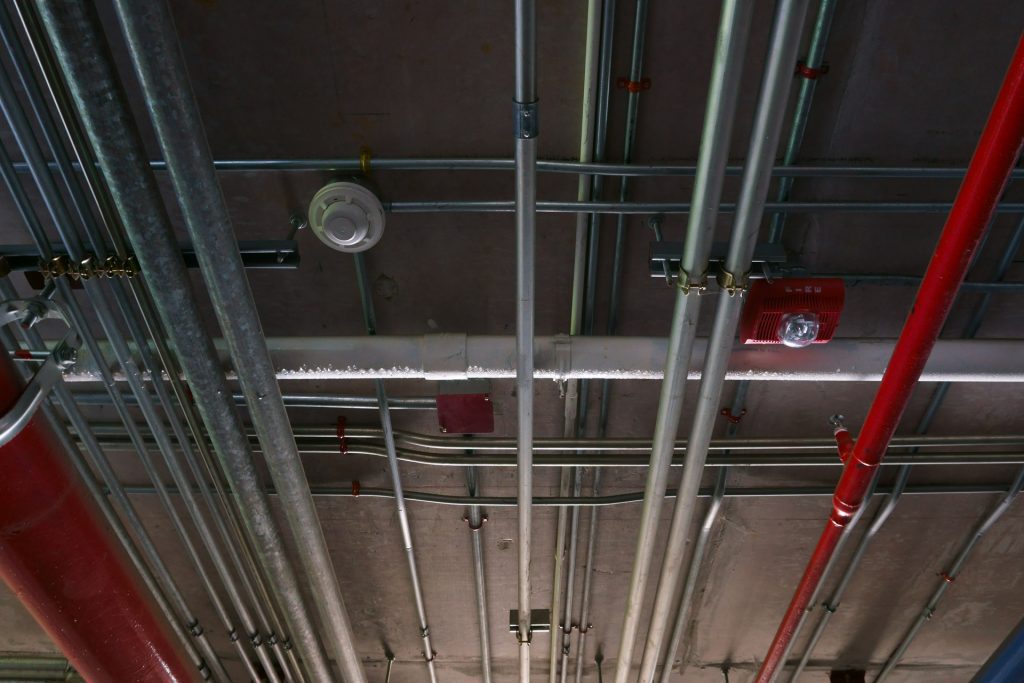
Portable cabins and modular offices need the same disciplined cabling as permanent buildings, adapted to prefabricated walls and frequent relocation. Our low current systems team typically designs:
- Copper cabling to each workstation, printer, phone and access point, with outlets planned on the furniture layout.
- Fiber or outdoor-rated backbone cables between separate office blocks, the gatehouse and the camp.
- Underground ducts or protected routes for external cables, coordinated with roads and other utilities.
- Containment inside cabins that respects wall panels and allows modules to be split for relocation.
- Labelling, testing and test records for every link, handed over in the as-built documentation.
Factory installation of cabling during cabin manufacture saves time on site, but only if the layout is frozen early. That is one reason the IT layout should be part of the TCF design and engineering drawings from the start.
Wi-Fi Across Offices, Yards and Camps
Steel-framed and metal-clad cabins block radio signals far more than ordinary walls, so a single router rarely covers a site office compound. A planned Wi-Fi design places access points inside each block, outdoor units where coverage is needed between buildings, and a central controller to manage roaming and security. Separate wireless networks, isolated from each other, should serve project staff, visitors, worker accommodation and devices such as cameras. Worker Wi-Fi has become a meaningful part of camp welfare, as we explain in our article on worker welfare facilities in construction camps.
Meeting Rooms and Audio-Visual Systems
Site meeting rooms host progress meetings, design reviews and client visits, often with participants joining remotely. A practical setup includes a large display or projector, a conference camera and microphone system suited to the room size, wireless screen sharing and a wired connection for reliability. Cabins have hard, reflective surfaces, so acoustic panels and soft finishes make a real difference to call quality. Power and data outlets at the table, good lighting and quiet air conditioning complete a room that people actually want to use.
Network Room Cooling and Backup Power
The network room, even if it is only a small comms room with one or two racks, is the heart of the site IT system. In Saudi heat it needs special attention:
- Dedicated cooling: a dedicated air-conditioning unit, preferably with a second unit for redundancy, sized by our HVAC engineers for the equipment heat load, not just the room size.
- Temperature monitoring: alarms that alert the IT team before equipment overheats.
- Dust protection: a sealed room, filtered air and regular cleaning, since dust shortens equipment life.
- UPS: an uninterruptible power supply to carry the network through outages and generator changeovers.
- Generator or grid backup: connection to the site standby power, with the comms room on an essential circuit.
- Earthing and surge protection: designed by our electrical team to protect equipment from faults and lightning.
On remote or off-grid sites, a hybrid system with solar PV and batteries can keep communications, CCTV and essential lighting running while reducing generator hours.
Security, Management and Support
Construction sites are temporary, but the data on them is valuable. Basic protections include a business-grade firewall, network segmentation so that guest and worker traffic cannot reach project systems, secure remote access for head office, regular backups and controlled admin access. Owners and government clients often have their own IT and cybersecurity requirements, including rules for connecting to their systems, so confirm them during pre-construction. Agree who supports the network day to day, how faults are reported and how quickly they must be fixed. CCTV and access control networks, covered in our guide to security and CCTV for construction sites, should sit on their own segment. For the wider office setup, see temporary site offices in Saudi Arabia.
Connect Your Site with BoldTarget
BoldTarget delivers site office IT infrastructure as part of complete temporary facilities: cabling, Wi-Fi, CCTV, access control, network room cooling and backup power, coordinated with the offices and utilities by one contractor. See our temporary construction facility project in Saudi Arabia, then contact BoldTarget to plan a site network that stays online from mobilization to handover.
Frequently Asked Questions
What is the best internet option for a construction site office in Saudi Arabia?
Fiber is usually best where the network reaches the site, because it is fast and stable. Where fiber is not available or not yet installed, 5G or 4G routers with external antennas are quick to deploy. Remote sites often rely on licensed satellite services, and critical sites should have a backup link from a different technology.
Why is Wi-Fi coverage poor in portable cabins?
Metal-clad and steel-framed cabins block radio signals much more than ordinary walls. Good coverage needs access points inside each block and outdoor units between buildings, managed by a central controller, rather than a single router.
Does a site office network room need its own air conditioning?
Yes. Network equipment produces heat and the Saudi climate adds a heavy load, so a dedicated unit sized for the equipment, ideally with redundancy and temperature alarms, protects the system. Dust sealing and a UPS on standby power are also important.
Should worker accommodation have Wi-Fi?
Many projects now provide Wi-Fi in worker accommodation as part of welfare, because it helps workers stay in touch with family. It should run on a separate network isolated from project systems and CCTV, with fair-use controls to protect bandwidth.
Related TCF Guides
- Construction Camp Waste Management: A Practical Guide for Saudi Sites
- Camp O&M and Facility Management for Construction Camps
- Temporary Construction Facility Services Saudi Arabia: Full Guide
- Temporary Warehouses for Construction Sites in Saudi Arabia
- TCF contractor in Saudi Arabia: explore our Temporary Construction Facilities services